
Unlocking 'unmortgageable' properties.

Summary of report
This report explores the scale and impact of the UK’s “unmortgageable” homes, with over 1.5 million properties excluded from mainstream lending, trapping £300bn in equity.
It examines the key barriers, from property condition and environmental risks to legal complexities and non-standard construction. Often concentrated in urban areas, these challenges restrict access to finance, suppress supply and slow market movement.
Yet many of these homes remain viable, and a more flexible, specialist approach to lending could help unlock value, supporting buyers, investors and the wider economy.
Skip to:
The scale of the issue

Over 1.5 million
Unmortgageable homes
across the UK

101,283
Post-war non-standard properties
in Birmingham alone

~£300bn
Equity value trapped
in unmortgageable homes
If you’ve ever been told that the property you’re looking to buy or refinance is unmortgageable, you’re not alone.
Every year, thousands of mortgage applications are rejected based on the property alone.
Often, automated processes turn down borrowers in seconds, before the full context of the individual or property can be considered. At Together, we’ve identified over 1.5 million UK homes that would sit in this category. That’s a sizeable portion of housing stock that remains effectively locked out of mainstream lending.
However, this figure only tells part of the story. Our research captures only the most visible examples, such as non standard construction and certain higher risk property types. Adding in other reasons for rejection, including structural issues, environmental risks, and legal complexities such as short leases and flying freeholds, means that the actual figure could be substantially higher.
In this report, we explore why different property types are typically rejected, the areas of the country hardest hit, and how unlocking these properties could help buyers, owners, investors and landlords alike, as well as the housing market and wider economy as a whole.
Properties rejected based on condition
Uninhabitable properties
- 323,000 English homes lack basic modern facilities
- £7000 average price of a new bathroom in 2026
- 3.5 million houses fail to meet Decent Homes Standard
No bathroom? No kitchen? No mortgage.
Lenders usually require homes to meet a basic living standard before agreeing a mortgage. That means if it lacks washing or cooking facilities, or other features that would make it unsafe to live in immediately, it can be extremely difficult to secure a long-term mortgage.
These homes are great examples of perfect fixer-uppers (for first-time buyers and expanding families) or rental opportunities, often available below the average market price for similar sized properties in the same area. They also offer the potential to add value that isn’t reflected in the initial purchase price.
Deterioration and defects
- 10% private rental homes with damp or mould
- 1.39m homes affected by Japanese Knotweed in the UK
- £12,500 average cost of fixing subsidence
The ‘sinking’ feeling.
As the UK’s housing stock continues to age, issues such as subsidence, rot and damp continue to affect mortgage applications. But deterioration and defects aren’t confined to the building itself, with invasive Japanese knotweed affecting nearly 1.4 million UK homes.
Many of these issues are identified during valuations, often becoming a decisive factor in whether a lender proceeds, reduces the loan, or declines the application altogether. In many cases, this can also limit the pool of buyers to those able to proceed with specialist finance or cash.
However, much like uninhabitable homes, these issues can often be resolved, while others, such as Japanese knotweed, can be effectively treated and managed. This can restore value to the property and prevent further deterioration that could lead to abandonment.
How specialist finance can unlock properties in poor condition
Short-term finance can play a key role where condition is the main barrier to lending.
By funding the purchase, and in some cases supporting the cost of improvement, a bridging loan allows buyers and investors to carry out essential works on properties that fall below standard requirements and move them into longer-term lending once complete.
Property auction finance can also support buyers picking up uninhabitable property or assets with defects at auction.
The wider housing market impact of condition-related lending restrictions
When condition prevents access to finance, homes are more likely to sit empty, sell below potential value, or fall further into disrepair.
At scale, this reduces the quality and availability of housing, particularly in areas where older stock makes up a large proportion of the market.
Properties rejected based on location
Commercial properties nearby
- 16% of all commercial term cases at Together were semi-commercial (2025)
Too close for comfort
Living next door to a pub or takeaway might be convenient, but with most mainstream lenders it can make securing a mortgage more challenging. The same applies to properties located near petrol stations, car repair garages or industrial units, where perceived risks around noise, traffic, anti-social behaviour, waste and potential hazards are higher.
Properties that are physically connected to commercial premises, such as flats above shops, can also present complications. Even where the title is purely residential, some lenders may restrict lending due to proximity or building type.
Where both the residential and commercial elements sit on the same title, the property may be classed as semi-commercial or mixed-use, which can further limit lender choice and typically requires a specialist approach.
But, with housing demand remaining high in many towns and cities, unlocking these properties could open up a segment of housing stock that is currently overlooked, particularly in high-demand urban areas.
A typically lower purchase price compared to similar homes in purely residential areas can also make these residential or semi-commercial properties attractive to landlords seeking stronger rental yields.
Flooding
- 6.3m homes and businesses currently at risk of flooding in England
- 1 in 4 homes will sit in designated flood zones by 2050
- 100,000 new builds expected to be built in high risk zones in the next five years
A rising tide in rejections
Flood risk isn’t always an immediate no from lenders, but tightening criteria around flood exposure is making mortgage applications more complex, often resulting in lower valuations, stricter terms, and, in some cases, rejection.
What’s changed in recent years is how the risk is assessed. Many lenders have started using advanced mapping to project which areas could be at risk from flooding in the future, flagging millions of properties currently sat outside a flood zone or with no previous flooding as a potential risk.
Combined with the proposed end of Flood Re, a government backed scheme keeping flood insurance affordability down, in 2039, it means that even more people will struggle to remortgage, sell or buy in the affected areas as we approach the middle of the century.
Without continued access to finance, there is a risk that housing in these areas becomes increasingly stagnant, with more properties falling into long-term vacancy or disrepair.
Flying freeholds
- <15% max total ‘flying’ floor space allowed by many major lenders
- 1% - 5% average discount applied by surveyors due to flying freeholds
- £100 - £300 flying freehold indemnity insurance policy one-off cost
Are these properties being overlooked?
Flying freeholds are more common than many buyers think and are typically found in older terraces or homes that have had extensions or conversion added where part of the property extends over a neighbouring space without full ownership of the land beneath.
They’re perfectly legal but can introduce complications for lenders, particularly where legal agreements aren’t clearly defined. It means that these properties can be harder to assess, and ultimately harder and slower to finance.
As a result, some mainstream lenders apply tighter criteria, reduce loan sizes, or avoid these properties altogether, limiting the pool of buyers and restricting movement in the market. However, many flying freeholds operate without day-to-day issues and are often rejected more because of their complexity than any genuine risk, even where appropriate legal protections are in place, such as indemnity insurance or clearly defined access and repair rights.
How specialist finance can support complex location-based cases
Where location introduces complexity, such as proximity to commercial premises or flood exposure, a more flexible approach to underwriting can support cases that fall outside standard criteria.
This allows lenders to assess risk in context, rather than applying broad restrictions based on postcode or property type alone.
Property auction finance can also support buyers picking up uninhabitable property or assets with defects at auction.
The wider housing market impact of location-related lending restrictions
Location-based restrictions can create uneven access to finance, even within the same town or city.
Over time, this can affect demand, pricing and transaction volumes in certain areas, leaving otherwise viable housing underused or overlooked.
Properties rejected based on asset type
Listed building
- 92% UK listed buildings are Grade 2 / B
- 382,216 listed buildings in England
- 1990 Planning (Listed Buildings and Conservation Areas) Act
Protected but not supported
Listed buildings play an important role in preserving the UK’s architectural and cultural heritage, but that protection can introduce additional complexity for lenders. Restrictions around alterations, repairs and materials can increase both cost and time, making future value harder to predict.
As a result, many mainstream lenders apply tighter criteria, particularly where significant works are required, or ongoing maintenance costs are uncertain. This can make listed properties harder to finance, limiting the pool of buyers despite strong demand for period homes in many parts of the country.
In reality, listed properties, from Georgian terraces to thatched cottages, are often well maintained and highly desirable, particularly in established markets. However, additional regulatory requirements and perceived risk mean they are more likely to fall outside standard lending criteria than comparable non-listed homes.
Non standard construction
- 503,914 timber framed homes in UK
- 387,037 prefabricated / system build house in UK
- Up to 250,000 pre-cast reinforced concrete (PRC) buildings in UK
Built differently. Assessed differently.
Non standard construction covers a range of property types, from post-war concrete builds to timber-framed and steel structures. While often structurally sound, their unconventional build can make them harder for lenders to assess.
Concerns around durability, resale value and comparable valuations mean many mainstream lenders apply stricter criteria, reduce loan sizes, or decline applications for non standard construction mortgages altogether. As a result, these homes can be harder to finance, limiting access for buyers despite often being more affordable than traditional properties.
Cladding
- 4378 buildings in need of remediation
- 20% identified buildings with active remediation
- £1,843 per m2 average cost of remediation (2020 – 25)
Balancing safety and housing mobility
In the wake of the Grenfell disaster, lenders began to take a much closer look at the safety risks associated with cladding on high-rise buildings, leading to stricter criteria and more detailed assessment of building safety.
Nearly a decade on, many flat owners who bought before these changes remain unable to sell, with prospective buyers often unable to secure a mortgage. In some cases, owners are also unable to use their property as security to access the funding needed to carry out remedial works.
Without viable routes to finance, these properties risk remaining tied up in the market, limiting housing mobility and delaying necessary improvements to building safety.
Short leases
- 5 million homes in England and Wales are leasehold
- 80 years is where lease extension costs rise significantly
- May 2026: Government confirms plans to ban new leaseholds on flats
Running out of time
Short leaseholds are a common but often overlooked barrier to securing a mortgage. As leases get shorter (typically below 80 years), properties lose value, as fewer buyers and lenders are willing to get involved.
Many mainstream lenders require a minimum lease length, meaning properties in good condition and desirable locations can still fall outside standard criteria.
For buyers and existing owners, this can limit mortgage options and make properties harder to sell or remortgage over time. However, with the right funding, extending the lease can unlock value and improve future finance options, creating opportunities where others see risk.
Proposed government reforms, reaffirmed in the May 2026 King’s Speech, aim to make lease extensions easier and more affordable, building on earlier plans for 990-year extensions and the removal of ‘marriage value’.
How specialist finance can support complex property types
Properties that fall outside standard definitions, whether due to construction type, legal structure or building safety, often require a more detailed and case-by-case assessment.
Specialist lending can support these scenarios by working through the specific risks, rather than excluding them entirely.
Property auction finance can also support buyers picking up uninhabitable property or assets with defects at auction.
The wider housing market impact of property-type lending restrictions
When entire categories of property are harder to finance, it limits buyer choice and restricts movement across the market.
This is particularly significant where these property types offer more affordable or high-demand options, as reduced access directly impacts housing supply and mobility.
Short leases can also slow down sales and limit remortgaging options, even in active markets, as fewer lenders are willing to offer finance.
Mapping the unmortgageable
Properties that fall outside mainstream lending criteria are heavily concentrated in certain parts of the UK, particularly major urban areas with older housing stock.
For example, Birmingham alone has over 193,000 properties with poor or very poor wall efficiency, including more than 100,000 built during the post-war boom between 1950 and 1975.
Similar patterns can be seen across Leeds, Liverpool and parts of London, where large volumes of post-war housing, often classed as non-standard construction, sit alongside older Victorian and Edwardian homes.
Combined, these property types continue to play a major role in how lenders assess risk today.
In these areas, demand remains high, but access to finance can be more limited, making it harder for buyers to secure housing in some of the UK’s most active markets.
Properties with poor / very poor wall efficiency
Top 10 local authorities
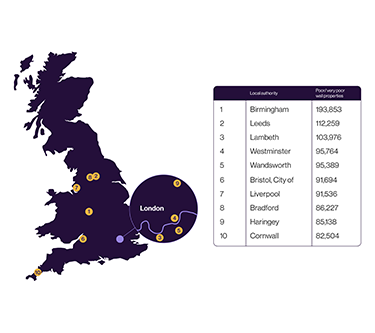
| Local Authority | Poor/Very Poor Wall Properties | Key Characteristics | |
|---|---|---|---|
| 1 | Birmingham | 193,853 | Largest single LA; post-war council estates; Wimpey No-Fines stock |
| 2 | Leeds | 112,259 | Industrial Victorian terraces + post-war system build estates |
| 3 | Lambeth | 103,976 | Dense flatted stock; converted Victorian terrace and mansion blocks |
| 4 | Westminster | 95,764 | High-value converted mansion flats; pre-1900 solid wall stock |
| 5 | Wandsworth | 95,389 | Converted Victorian and Edwardian terrace stock |
| 6 | Bristol, City of | 91,694 | Mixed Victorian and post-war; solid-wall terraces |
| 7 | Liverpool | 91,563 | Pre-war terrace stock; post-war deck-access blocks |
| 8 | Bradford | 86,227 | Stone-built pre-1914 terraces; non-standard post-war estates |
| 9 | Haringey | 85,138 | Dense pre-war flatted stock; high proportion of poor-EPC flats |
| 10 | Cornwall | 82,504 | Rural/coastal; granite and cob-walled older stock; timber frame |
| 11 | Barnet | 81,667 | 1930s–1950s semi-detached; some system build |
| 12 | Lewisham | 78,744 | Victorian terrace conversion; deck-access council blocks |
| 13 | Croydon | 77,022 | Edwardian suburban terrace; 1960s tower blocks |
| 14 | Kensington & Chelsea | 76,994 | High-value Victorian/Edwardian mansion flats; solid walls |
| 15 | Ealing | 76,161 | Pre-war semi-detached; 1960s council flat stock |
| 16 | Camden | 75,937 | Victorian terrace; large mansion block flat stock |
| 17 | North Yorkshire | 74,822 | Rural isolated; traditional stone and cob construction |
| 18 | Hammersmith & Fulham | 72,817 | Victorian/Edwardian converted terrace; solid wall flats |
| 19 | Brighton & Hove | 72,497 | Regency/Victorian solid wall stock; flatted conversions |
| 20 | Manchester | 70,657 | Post-war system build; Victorian terrace; pre-fab estates |
Post-war non standard properties built 1950 to 1975
Top 10 local authorities
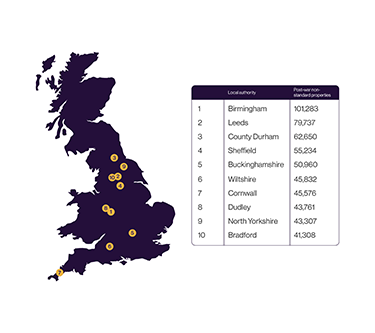
| Local Authority | Poor/Very Poor Wall Properties | Key Characteristics | |
|---|---|---|---|
| 1 | Birmingham | 101,283 | Extensive Wimpey, Bison and Reema stock; Chelmsley Wood, Castle Vale estates |
| 2 | Leeds | 79,737 | Seacroft, Halton Moor, Belle Isle system build council estates |
| 3 | County Durham | 62,650 | Post-war mining community regeneration; semi-detached system build |
| 4 | Sheffield | 55,234 | Park Hill era; Kelvin flats (demolished); ongoing non-standard stock |
| 5 | Buckinghamshire | 50,960 | New-town overspill; Aylesbury Vale post-war estates |
| 6 | Wiltshire | 45,832 | Military and rural system build; post-war market town expansion |
| 7 | Cornwall | 45,576 | Post-war rural and coastal regeneration housing |
| 8 | Dudley | 43,761 | West Midlands conurbation; post-war system build council estates |
| 9 | North Yorkshire | 43,307 | Market town expansion; some Airey and Cornish unit housing |
| 10 | Bradford | 41,308 | Buttershaw and Holmewood system build estates |
What does unlocking unmortgageable properties mean for...?
Whilst the challenges explored in this report are often experienced at an individual level, they are rarely isolated. Barriers to finance in one transaction can quickly ripple across the wider property chain, delaying sales, limiting investment, and constraining supply.
Our expert team discuss the impact on each segment of the market, and the potential benefits that unlocking unmortgageable properties could bring, not just for buyers and investors, but for the housing market and wider economy.

Home buyers
But as lender risk appetites have tightened, that route has narrowed. Many properties now fall outside standard criteria or are valued in ways that make them unaffordable, even where there’s clear potential or they’re perfectly habitable, as is often the case with non standard builds.
The result is that first-time buyers and growing families are being shut out of opportunities that would previously have been within reach. It also puts further strain on an already fragile property chain, potentially trapping homeowners in properties they’re unable to sell despite high demand.
What’s needed is a more flexible approach to finance — one that looks at a property’s potential, not just where it sits against standard criteria today. Whether that’s funding refurbishment or simply unlocking properties that fall outside the norm, it’s key to bringing this stock back into use and giving more people a realistic path into home ownership.”
Ryan Etchells, Chief Commercial Officer, Together

Landlords and investors
Below-market-value opportunities are key to this approach, offering the greatest potential for uplift — whether that’s through refurbishment, improving energy efficiency, or simply unlocking value where properties fall outside mainstream criteria. However, accessing finance for these types of projects remains a challenge through traditional lenders.
Specialist funding plays a critical role here. By providing short-term finance to support both acquisition and improvement, landlords and investors can move quickly, execute their strategy, and ultimately grow their portfolios with confidence.”
Mark Eastwood, Corporate Sales Director, Together

Tenants
Unlocking these properties means more homes can be brought into use where they’re needed most. That improves choice, raises the overall quality of rental stock, and helps ease some of the pressure in areas where demand consistently outstrips supply. It also supports movement across the wider market, which ultimately benefits tenants whether they plan to keep renting or move towards home ownership.”
Michelle Walsh, Director Intermediary Sales, Together

Intermediaries and mortgage brokers
What that means is brokers are spending more time trying to place cases that would have been straightforward a few years ago. Deals are falling over at valuation, being declined late in the process, or simply not getting off the ground because the property doesn’t tick the right boxes — even when there’s a perfectly viable lending story behind it.
And, actually, many of these ‘unmortgageable’ properties can be accepted. Brokers just need to find a lender that understands the reality facing clients, who’ll look beyond simple criteria, and can support with flexible, viable and sensible short-term and long-term products.”
Tanya Elmaz, Managing Director Intermediary Sales, Together

The housing industry and wider economy
That creates a wider issue. With housing supply under pressure and affordability stretched, leaving viable homes underused is a missed opportunity, particularly when much of this stock could be brought back into use relatively quickly. Specialist finance plays an important role here. Short-term solutions like bridging allow buyers, landlords and investors to step in, carry out essential refurbishment, and move properties back into longer-term lending.
At scale, that activity helps bring quality homes back into circulation, supports local economies through construction and professional services, and ensures these properties don’t become long-term dead stock.
Ultimately, unlocking these homes is about making better use of existing housing, helping them move from the margins into active use within a more functional housing market.”
Richard Rowntree, Group Chief Executive Officer, Together
Key takeaways
Unlocking ‘unmortgageable’ properties isn’t about lenders taking on more risk. It’s about taking the time to understand the real-world scenarios and circumstances that many borrowers find themselves in.
Across the UK, a significant proportion of housing stock sits outside standard lending criteria at any given time. But in many cases, these properties are viable, valuable and in demand, held back more by rigid criteria than risk.
At Together, we take a different approach. By looking at each case on its own merits, rather than applying blanket rules, we help clients and brokers access funding where others can’t. Whether the challenge is property condition, construction type, location or complexity, our team works to find a way forward.
If you have a case that doesn’t fit the mould, we’re ready to look at it.
Your home may be repossessed if you do not keep up repayments on your mortgage.

Methodology and references
Methodology
The analysis was conducted using Searchland property intelligence data and supplementary government and industry datasets.
Searchland data was used to identify residential properties exhibiting characteristics commonly associated with restrictions under mainstream mortgage lending criteria, including non standard construction, poor wall efficiency ratings, listed status and other specialist property features. Data included homes in England, Wales and Scotland. Together does not lend in Northern Ireland.
Mortgage lending criteria vary between lenders and over time, and references to "unmortgageable" properties throughout this report refer to properties that may fall outside some mainstream lending criteria rather than being incapable of securing finance altogether.
Sources
Searchland; Together Market Intelligence Report (May 2026); English Housing Survey; Environment Agency; UK Government Building Safety Remediation data; Planning Data Platform; HomeOwners Alliance; Checkatrade; HomeProtect; SAM Conveyancing; Peppercorn Law; Parkers Properties; LoopNet UK; The Guardian and other sources cited throughout the report.
