
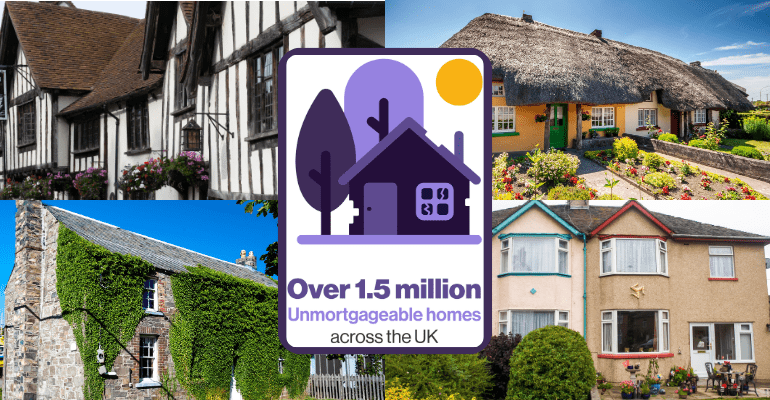
Built different: Funding the non-standard homes some lenders call unmortgageable.
What comes to mind when you hear the word 'unmortgageable'?
Perhaps it's a thatched cottage, a fixer-upper requiring extensive renovation, or a unique home that doesn't fit the mould.
In reality, properties typically rejected by banks and high street lenders come in many forms. Some are historic and highly desirable. Others are among the most common homes in the country. Yet both can face the same challenge: falling outside standard lending criteria.
That doesn't necessarily mean finance is unavailable.
At Together, we've identified more than 1.5 million UK properties that could fall outside standard lending criteria due to factors such as construction type, condition, location or legal complexity. While some lenders may view these homes as too difficult to assess, many still represent fantastic opportunities for buyers, homeowners, landlords and investors.
Whether you're trying to buy an unusual property, remortgage a home you've owned for years, or release equity for improvements, understanding why certain homes are considered difficult to finance is the first step.
What is an unmortgageable property?
Despite the name, an unmortgageable property is not necessarily a property that can never be financed. It means the property falls outside the lending criteria of a particular mortgage provider.
This could be because:
- The property is of non-standard construction.
- Significant repairs are required.
- The building is listed.
- There are concerns around flooding or structural issues.
- The property is difficult to value.
- The lender believes the home could be difficult to sell in the future.
One lender's rejection doesn't automatically mean every lender will reach the same conclusion.
Why are more properties falling outside mainstream criteria?
Mortgage lenders have always assessed risk, but advancements in automated underwriting and increasingly detailed property assessments mean some applications are rejected before the full circumstances can be considered.

The issue isn't limited to unusual homes either. Some of Britain's most challenging properties to finance are also some of its most common.
That's because properties can fall outside mainstream criteria for very different reasons.
For example:
- Historic and heritage properties.
- Non-standard construction homes.
- Properties requiring repairs or improvement.
Historic and heritage homes
Many buyers dream of owning a character property.
From Georgian townhouses, converted chapels and even restored derelict buildings to Grade II listed homes and thatched cottages, these buildings form an important part of Britain's architectural heritage. England alone has more than 382,000 listed buildings, with approximately 92% classified as Grade II.
Yet the very qualities that make these properties attractive can also make some lenders cautious. Unlike many non-standard construction homes, historic properties are often rejected not because they're common, but because specialist repairs, maintenance requirements and planning restrictions can make future costs harder to predict.
Listed status often means:
- Additional permissions may be needed for alterations.
- Repairs can require specialist materials or skills.
- Maintenance costs may be higher.
- Future works can take longer and cost more than expected.
For homeowners, this can create challenges not only when purchasing the property but also when remortgaging or releasing equity to fund improvements later.
Can you get a mortgage on a listed building?
Yes, many people do.
However, lender appetite can vary significantly depending on the property, its condition and any planned works.
This is why specialist lenders often play an important role in helping buyers and homeowners finance historic properties that don't fit standard lending models.
Non-standard construction homes and mortgages
Many people assume non-standard properties are rare. They’re actually incredibly common and can be found throughout the UK.
Our research found there are:
- More than 387,000 prefabricated or system-built homes.
- Up to 250,000 pre-cast reinforced concrete (PRC) properties.
Many were built as part of Britain's post-war housing programme and remain family homes today. Yet they can still present challenges when applying for a mortgage or remortgage because some lenders have concerns around:
- Construction methods.
- Long-term durability.
- Valuation comparables.
- Future saleability.

Did your city see a post-war housing boom?
After the Blitz, Britain had to build back quick, often using easy, readily available construction materials like concrete.
Necessary then. A nightmare now for millions trying to get finance on their non-standard home.
Find out which local authorities have the most non standard properties built between 1950 and 1975 in our latest report.
What is a non-standard construction mortgage?
A non-standard construction mortgage refers to lending secured against a property that isn't built using traditional brick or stone walls and a tiled or slate roof.
Examples can include:
- Timber-frame homes.
- PRC houses.
- Steel-frame properties.
- System-built homes.
- Other alternative construction types.
While some mainstream lenders restrict lending on these properties, specialist lenders may consider them on a case-by-case basis.
What if you've lived in the property for years?
You may have purchased or inherited an unusual or non-standard property decades ago with few issues. This means that you probably didn’t need to go through the difficult mortgage application process that many first-time buyers or home movers now face.
However, your circumstances may have changed over the years, and you may need to access finance using your home as security. For example, you might want to:
- Remortgage onto a new deal.
- Release equity to fund renovations.
- Carry out energy-efficiency improvements.
- Consolidate borrowing.
- Raise funds following inheritance planning.
At that point, the property's construction type can suddenly become a factor in financing decisions.
Properties requiring repairs or improvement
Not every unmortgageable property is unusual. Sometimes, the issue is simply the current condition.
According to our latest ‘Unlocking unmortgageable properties’ report:
- Around 323,000 homes in England lack basic modern facilities.
- Around 3.5 million homes fail the Decent Homes Standard.
Missing kitchens, missing bathrooms, severe damp, subsidence and other structural issues can all affect mortgage applications.
This often creates an opportunity. Properties requiring work can sometimes be purchased below market value because fewer buyers are able to secure finance. For homeowners, funding essential repairs can also help protect the property's value and improve future financing options.
Can you get a mortgage on a property that needs renovation?
If a property is considered uninhabitable, mainstream mortgage options that could be used to renovate or repair your property may become more limited.
In these situations, specialist finance such as bridging loans can provide an alternative route by helping fund the purchase while improvements are carried out. Subject to lending criteria, the borrower may then refinance onto a longer-term solution once the work is complete.
It's not just the property that can be considered 'non-standard'
Increasingly, borrowers themselves are becoming more complex.
- A person buying a listed cottage may also be self-employed.
- A homeowner living in a timber-frame property may have multiple income streams.
- A first-time buyer looking to renovate an old home may have a ‘less-than-perfect’ credit history.
Again, these situations often fall outside the straightforward lending scenarios preferred by some mainstream providers.
That's why specialist lending increasingly focuses on understanding the bigger picture surrounding both the borrower and the property. At Together, it means that we can work through multiple challenges individually, at speed and with a common sense approach.
Why specialist lenders take a different view
Mainstream lenders often rely heavily on standardised criteria. Specialist lenders are designed to be more flexible.
Rather than simply assessing whether a property fits a predefined category, they may consider:
- The property's overall merits.
- The borrower's wider circumstances.
- Planned improvements.
- Exit strategies.
- Future value potential.
This approach can be particularly valuable when dealing with properties that sit outside traditional lending norms but nevertheless represent sound opportunities.
Built different doesn't mean impossible to finance
A Grade II listed cottage in the countryside and a PRC house on a post-war housing estate may have very little in common. After all, one is defined by its history, and the other by its construction.
Yet both can encounter exactly the same lending challenge: falling outside standard mortgage criteria. Being labelled unmortgageable doesn't automatically mean a property lacks value, potential or financing options. In many cases, it simply means finding a lender willing to understand the full story.
Want to learn more?
Our latest Unlocking the Unmortgageable report explores the UK's 1.5 million properties that could fall outside mainstream lending criteria, examining the challenges facing buyers, homeowners, landlords and brokers, and the opportunities that specialist finance can unlock.
If you've been told your property is too unusual, too complex or even unmortgageable, it doesn't necessarily mean you've reached the end of the road.
Whether you're buying, releasing equity from, or remortgaging a property that's been declined elsewhere, our specialist lending team may be able to help.
Just like your home, our criteria is built different.
Unlock your optionsSimilar articles
-

First-time buyer lands dream village home at auction
3 minPersonalAuction Finance -

Undesirable to undeniable: The overlooked commercial assets many lenders won’t fund
2 minBusinessBridging LoanDevelopment Finance -

£65,000 Refurbishment Bridging Loan helps a retired couple fix their rotten roof and sell their family home
2 minPersonalBridging Loan

Any property, including your home, may be repossessed if you do not keep up repayments on your mortgage.
All lending decisions are based on lending criteria and, where applicable, subject to credit check and an assessment of individual circumstances.
All mortgages are subject to our terms and conditions.
Loans offered by Together Commercial Finance Limited are not regulated by the Financial Conduct Authority.
Articles on our website are designed to be useful for our customers, and potential customers. A variety of different topics are covered, touching on legal, taxation, financial, and practical issues. However, we offer no warranty or assurance that the content is accurate in all respects, and you should not therefore act in reliance on any of the information presented here. We would always recommend that you consult with qualified professionals with specific knowledge of your circumstances before proceeding (for example: a solicitor, surveyor or accountant, as the case may be).