
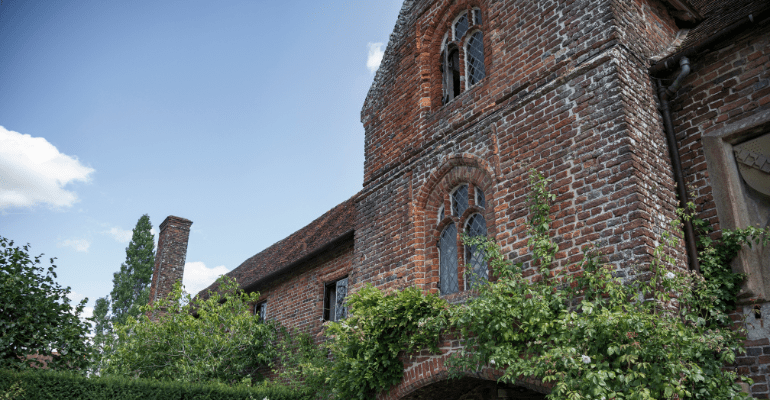
The LGBTQ+ legacy behind two iconic English estates: Knole and Sissinghurst Castle Garden.
More than just bricks and mortar, our homes play a private, personal part in our lives. The backdrop to our triumphs and adversities, spaces that can encourage freedom, expression and aspiration, we can also imprint on them as much as they do on us.
As we reflect on LGBTQ+ History Month, it’s a fitting moment to revisit the life of Vita Sackville-West, a celebrated writer, horticulturist, estate owner, gay icon and former lover of renowned feminist writer Virginia Woolf.
It’s a story of love, loss, grief and redemption, told through the lens of the two famous properties that shaped her life – Knole and Sissinghurst Castle Garden, highlighting the lasting legacy she left on both estates, and how barriers to property ownership have long affected people whose lives didn’t fit the conventions of their time.

Knole: A house built on power and privilege
With over 600 years of history, Knole House had already had a complex and checkered past before Vita was born.
Now a sprawling 170,000 sq. ft property near Sevenoaks in Kent, Knole can trace its heritage back as far as 1250 when a manor house was first built on the site.
However, the building we recognise today began to take shape around 1444. At that time, James Fiennes, known as Baron Saye and Sele, undertook an ambitious construction project, before his execution for inciting rebellion in 1450.
The home was then gifted, bought and inherited by a string of lords, archbishops and royals throughout the tumultuous Tudor era. In 1603, the estate finally became the property of Thomas Sackville, Lord Buckhurst and cousin to Elizabeth I, starting the Sackville-West’s history with Knole that still exists today.

Vita’s early life at Knole
Whilst Thomas Sackville may have made the biggest impact on the property itself, remodelling it from a Royal Palace into the family’s fashionable Jacobean era home, Knole left perhaps its most indelible imprint on his descendant, Vita.
Born within the walls of the great estate on 9th March 1892, Vita’s early life at Knole - and the Sackville family’s long history of privilege, artistic patronage and strict traditions - undoubtedly shaped her worldview and her later award-winning writings.
She penned more than a dozen novels, including The Edwardians, a critique of the aristocratic society of her day and a reflection on her own childhood, and All Passion Spent, which addresses people's - especially women's - control of their lives. Vita was also celebrated for her travel books and poetry; She was the only person to win the prestigious Hawthornden Prize for Literature twice in 1927 and 1933.

Vita and Virginia Woolf
But Knole doesn’t just shape Vita’s own writing. It captures the imagination of one of England’s most celebrated literary figures – Virginia Woolf.
The two shared a deep romantic relationship during the 1920’s, with Woolf fascinated by Vita’s upbringing, her devotion to Knole, and the emotional toll that the Sackville-West heritage had on her.
Woolf even immortalises her lover in Orlando, her 1928 opus. Described as ‘the longest and most charming love letter in literature’, the novel essentially returns Knole to Vita on the page.
Woolf’s original manuscript is still on show at Knole.
Knole takes on an almost mythic status as both Vita and Woolf describe it as a vast world that charms and haunts in equal measure.
It sets a scene where majesty and melancholy mirror a young Vita’s solitude and her burgeoning creativity and understanding of self and sexuality. It may sound like an unhappy childhood but Vita’s love for the historic estate, highlighted by her delight in showing visitors around it, shows that she had a profound connection to Knole.
It’s a deep emotional bond that makes what happens next so devastating.
The Heir: Injustice, betrayal and loss
As her father Lionel’s sole child, Vita felt very strongly that the property belonged to her and she should carry on her family’s legacy as custodian. Married to Harold Nicolson in 1913, in an open relationship where both had several same-sex lovers, the couple had two sons together, Benedict and Nigel.
However, the laws of the day and the family’s own customs meant that only male heirs on the Sackville-West side could inherit the property. This meant that not only would Vita be overlooked for inheritance, but so would her sons as they were both Nicolsons.
Upon Lionel Sackville-West’s death in 1930, Knole passed to his brother, and Vita’s uncle, Charles, and Vita was forced to leave the home that she loved.
This injustice ripples through several of Vita’s publications, even before her father’s death. The Heir: A love story, published in 1922, is a story about a man who inherits a country home they initially want to sell before forming an unbreakable bond to it. It’s both a love letter to Knole and a thinly veiled attack on patriarchal inheritance laws.
While Vita’s exclusion was rooted in gender and the rigid customs of her time, people today can still find themselves shut out of home ownership for very different reasons.
Equality in terms of gender and marital status may have changed, especially after the Sex Discrimination Act 1975 made it illegal for lenders to require a male guarantor, but many people still face barriers when their circumstances don’t fit standard criteria, from unconventional income sources to complex credit histories.
It’s why lenders like Together take the time to understand a person’s whole situation, not just a criteria checklist, to recognise the real stories and ambitions behind every application.
A place of her own: Sissinghurst Castle Garden
Looking for a new home, Vita and Harold looked settled on what was essentially a derelict ruin just 25 miles from Knole. The couple completed on the purchase of a once great Elizabethan manor in Sissinghurst, sadly left abandoned after lives as a prison and an army barracks, reflecting Vita’s emotional state at the time.
The property she decided to buy once belonged to Sir John Baker, whose daughter married Thomas Sackville, which is particularly poignant, as if Vita were claiming back a piece of her lost heritage.

Rather than just creating a substitute for Knole, Vita and Harold saw the potential to create something new and deeply personal.
They embarked on a thirty year love affair with the estate, transforming Sissinghurst into one of England’s most beautiful Grade I listed heritage sites.
Vita’s influence is writ large on the estate’s world-renowned gardens as well, with her experimental and undisciplined style credited with revolutionising early 20th Century gardening.
Vita’s writing and gardening ultimately became her way of resisting the traditions that confined her, from the inheritance laws that kept Knole out of reach to the social expectations placed on women and queer people of her time.
And in a twist of fate, as if prophesised years earlier in 1922’s The Heir: A Love Story, Sissinghurst became the place where Vita finally found the freedom and ownership she had been denied.
The same spirit of creativity, connection and ownership lives on today. Architect Ken Roscoe and his husband spent a decade transforming the 17th century farmhouse they’d rented, even creating an award-winning garden that Vita herself might’ve admired. When the opportunity came up to buy the property for themselves, the successful couple found that Ken’s complex income made it much harder to secure a mortgage.
Both Vita and Ken’s experience show how easily people can be excluded by systems that weren’t built for them.
Today, many potential property owners still face similar barriers when their circumstances don’t fit traditional lending criteria. As a specialist lender, Together has spent over fifty years supporting people with complex stories and unconventional paths, helping them move forward to realise their property ambitions when others are unable to help.
Similar Articles
-

First-time buyer lands dream village home at auction
3 minPersonalAuction Finance -

UK horticulturist buys stunning old hall for £2.5m - exclusive interview
1 minPersonalBusinessMortgage -

Saving a couple’s downsizing dream with a six-figure bridging loan after their lender pulls out
1 minPersonalIntermediariesBridging Loan
Any property, including your home, may be repossessed if you do not keep up repayments on your mortgage.
All lending decisions are based on lending criteria and, where applicable, subject to credit check and an assessment of individual circumstances.
All mortgages are subject to our terms and conditions.
Loans offered by Together Commercial Finance Limited are not regulated by the Financial Conduct Authority.
Articles on our website are designed to be useful for our customers, and potential customers. A variety of different topics are covered, touching on legal, taxation, financial, and practical issues. However, we offer no warranty or assurance that the content is accurate in all respects, and you should not therefore act in reliance on any of the information presented here. We would always recommend that you consult with qualified professionals with specific knowledge of your circumstances before proceeding (for example: a solicitor, surveyor or accountant, as the case may be).
